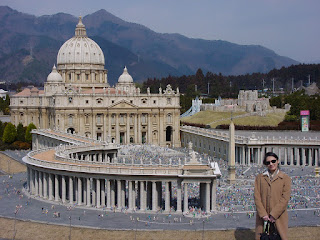
The Tobu World Square is a theme park located in Kikugawa Onsen exhibiting replicas in scale 1/25 of famous buildings from around the world. Models include ancient monuments, cultural treasures and UNESCO World Heritage Sites, which are reproduced with great detail. & Ride nbspDica: The miniature world in Tobu World Square in Tochigi The park is divided into area-based regions. In Zone Japan, visitors can see scenes from the country along with cultural sites of great importance, such as Himeji Castle, Dogo Onsen and Kyoto temples. Since the Asian Zone takes visitors to Korea and India, as well as major sites in China. & Ride nbspDica: The miniature world in Tobu World Square in Tochigi Another is Europe Zone, the largest and most diverse area of the park. Here, wonders like the Parthenon and the Colosseum are side by side with newer structures like the Eiffel Tower. Ahead is the Egypt area with the pyramids and the Sphinx, in addition to the American Zone, home of the Wh...
The meaning of the names of Japan's provinces 47 provinces in an area with only 377,900 square kilometers. Just to get an idea, Brazil is 22.5 times greater than the Japanese territory (8,516,000 square kilometers), and has fewer federal units that Japan (26 states and one federal district). But have you ever wondered what is the meaning of these provinces? Understand today these meanings and their origin and history, this special edition of Kanto! Kanto region Repr 1 - Ibaraki Province - 茨城 県 The Kairakuen Garden (Representation / Image: Wikipedia) Second in Ibaraki county article book Hitachinokuni Fudoki ( 常陸国風土記 ), which means something like topography of Hitachinokuni (one of the old provinces of Japan's former Local Government District system), to stop the thieves who roamed the region they created a thorn fence around the castle. In deed, he was noted as something "to stop thieves from Saeki who lived in a hole ...
4. Majide (マ ジ で / ま じ で) The Maji word is derived from Majime, which means serious. As slang can be used Maji or Majide and these expressions are used to show surprise in relation to something or to emphasize something. Can be considered a slang version of "hontou ni" it translates as: Really? Truth? example 1 マ ジ!あ の 人 カ ッ コ イ イ! Maji! Year hito kakkoi Oh really! That guy is beautiful. example 2 結婚 し た. Kekkon shita. I married. ジ で? マ! Majide ?! Oh really ?! 5. Hanpanai (ハ ン パ な い) Hanpanai is used to describe something very extraordinary thing or something extreme, outrageous or beyond imagination. It is mainly used in a positive way and can often be replaced by Yabai. example 1 あ の 子 の 才能 は ハ ン パ な い. Year ko in SAINO wa hanpanai. The talent of this child is amazing. example 2 昨日 は ハ ン パ な く 暑 か っ た Kino wa hanpa naku atsukatta Yesterday was absurdly hot. 6. Norinori (ノ リ ノ リ / の り の り) Norinori is derived from the word 乗 る (の る), which means walking, riding, ...